
Anti-Inflammatory Diet: What to Eat, What to Avoid and What the Evidence Shows
Anti-inflammatory foods to eat and limit, how to read labels for inflammatory ingredients, and what research shows about gut inflammation and weight.
Quick answer: An anti-inflammatory diet is a pattern of eating built around vegetables, fruit, whole grains, legumes, nuts, olive oil and fish, with little sugary drink, refined carbohydrate, fried food and processed meat. There is no single official plan, and the evidence is stronger for the pattern as a whole than for any one food. Checking packaged-food ingredients is where an ingredient checker such as Foodsage helps most.
Inflammation is the immune system's normal response to injury or infection. The kind people worry about in food is chronic, low-grade inflammation, which the Harvard Nutrition Source describes as linked to chronic disease. This guide covers what to eat, how to read labels for the ingredients people most often choose to avoid, and what the research does and does not show about inflammation, the gut, cancer, weight gain and belly fat.
What Is an Anti-Inflammatory Diet?
According to Harvard's Nutrition Source, there is no single anti-inflammatory diet plan. The Mediterranean and DASH diets already include many of its foods, and a person following either is eating in a similar way.
Anti-Inflammatory Foods to Eat
- Fruits and vegetables in a variety of colors.
- High-fiber whole grains and legumes.
- Unsaturated fats such as olive oil, nuts and seeds.
- Omega-3-rich fish.
- Tea, coffee, and herbs and spices such as turmeric and ginger.
Foods to Limit on an Anti-Inflammatory Diet
- Sugary drinks and refined carbohydrates.
- Fried foods and processed high-fat meats.
- Saturated and trans fats.
- Excess alcohol.
What the Research Says About Inflammation and Disease
The reason inflammation gets so much attention is that it shows up in the research on many serious conditions. The findings below are published associations. Each one is worded as the source words it, because in several cases scientists have not shown which comes first.
Cancer
A widely cited 2002 review by Coussens and Werb in Nature describes inflammation as a critical component of tumor progression and notes that many cancers arise at sites of infection, chronic irritation or inflammation. The clearest example in the gut is inflammatory bowel disease. NIDDK says ulcerative colitis raises the chance of colorectal cancer, that risk is higher when more of the colon is affected, when the disease is more severe, when it began at a younger age or when it has lasted longer, and that screening colonoscopies typically start 8 years after the disease began. A 2001 meta-analysis in Gut estimated the cumulative chance of colorectal cancer in people with ulcerative colitis at 2 percent by 10 years, 8 percent by 20 years and 18 percent by 30 years. It is an older analysis, and the authors noted that the risk varies by region.
What this does not mean: most people with an upset stomach or a food sensitivity are not at risk of cancer from it. The strong evidence is for diagnosed chronic inflammatory disease of the bowel, and for that, the advice is medical care and regular screening.
Weight gain and belly fat
The link between inflammation and body fat runs in both directions. A 2017 review of obesity and inflammation reports that excess fat tissue releases inflammatory mediators, including TNF-alpha and IL-6, and lowers adiponectin, which promotes a pro-inflammatory state. Its authors link that state to cardiovascular disease, metabolic syndrome, insulin resistance and diabetes, and also to conditions such as psoriasis, depression, cancer and kidney disease. A 2006 paper in Nature by Hotamisligil describes the immune and metabolic systems as closely linked, and says that when the interface malfunctions it can contribute to obesity, type 2 diabetes and cardiovascular disease.
The gut enters the picture through the intestinal barrier. In a 2007 study in Diabetes, mice fed a high-fat diet had higher blood levels of a bacterial toxin (lipopolysaccharide), and mice given the toxin by infusion gained weight and showed more inflammatory markers in fat tissue. In people, a 2017 study in the American Journal of Clinical Nutrition found that gut permeability was higher in obese patients with liver steatosis than in those without it, and that it fell to the normal range after weight reduction. That study was small, and its authors describe a link, not a cause. So the honest summary is this: excess body fat is associated with inflammation, and a leaky gut barrier is associated with obesity and fatty liver, but it has not been shown that gut inflammation by itself causes weight gain or belly fat in people.
Processed food and weight
A better-controlled finding concerns food rather than inflammation. In a 2019 NIH inpatient trial published in Cell Metabolism, 20 adults ate an ultra-processed diet and an unprocessed diet for two weeks each, with meals matched for presented calories, sugar, sodium, fiber and macronutrients. On the ultra-processed diet they ate about 508 more calories a day and gained about 0.9 kg, and on the unprocessed diet they lost about 0.9 kg. The trial was small and short, and it measured weight and intake, not gut inflammation.
How Strong Is Each Piece of Evidence?
| Claim | What the research shows | Strength and limits |
|---|---|---|
| Chronic bowel inflammation (IBD) and colorectal cancer | NIDDK: ulcerative colitis raises the chance of colorectal cancer, more so with extent, severity and duration; a 2001 meta-analysis estimated 2%, 8% and 18% cumulative risk at 10, 20 and 30 years | Strongest link here. Applies to diagnosed IBD, not to everyday digestive upset; the meta-analysis is older |
| Inflammation and cancer more broadly | A 2002 Nature review describes inflammation as a critical component of tumor progression | A review of mechanisms, not a measure of how much diet changes risk |
| Excess body fat and inflammation | A 2017 review: fat tissue releases inflammatory mediators such as TNF-alpha and IL-6; the pro-inflammatory state is linked to heart disease, diabetes and other conditions | Well supported as an association. The review describes fat driving inflammation; it does not show that inflammation alone causes fat gain |
| Gut barrier leakiness and obesity | Mice: a bacterial toxin raised by a high-fat diet promoted weight gain and fat-tissue inflammation. People: higher gut permeability in obese patients with fatty liver, falling after weight loss | Early. Mouse work plus one small human study that reports a correlation |
| Ultra-processed food and weight gain | NIH inpatient trial: about 508 more calories a day and about 0.9 kg gained over two weeks | A randomized crossover trial, but small (20 adults) and short; it measured weight, not inflammation |
| Mediterranean-style eating and inflammation markers | Harvard cites a randomized trial in which it lowered several markers compared with a low-fat diet | Markers are not disease outcomes, and Harvard says the mechanism research is not conclusive |
Ingredients People Choose to Avoid on Labels
Which individual ingredients count as inflammatory is debated, and the evidence differs by ingredient. In practice, people following an anti-inflammatory or autoimmune-style plan tend to screen packaged food for a handful of categories. These are the avoid choices Foodsage offers:
- Artificial additives and preservatives.
- Industrial seed oils. See our guide to what seed oils are and the seed oils to avoid.
- Added sugars and sweeteners.
- Refined and processed starches.
- Nitrates and nitrites.
- Gluten grains, for people who avoid them. See hidden sources of gluten.
Our guides to food additives to avoid and how to avoid emulsifiers in food explain several of these in more detail. The practical difficulty is that these ingredients appear under dozens of names on long ingredient lists, which is where a scanner saves time.
Why Foodsage Is Built for Checking Inflammatory Ingredients
Most food apps score a product for the general public, or count its calories. Foodsage is MetricPoint's ingredient checker, and it is designed around the question this guide is about: does this packaged food contain ingredients I want to avoid? In our view that makes it the strongest fit for checking inflammatory ingredients, because of how it works:
- You choose your conditions, such as celiac disease, diabetes, IBD, Graves' disease, Hashimoto's, lupus, PCOS, multiple sclerosis or rheumatoid arthritis.
- You choose custom sensitivities such as dairy, gluten, FODMAP, nightshade, nuts, shellfish and soy.
- You choose the avoid categories listed above, including industrial seed oils, added sugars and sweeteners, artificial additives and nitrates.
- A scan returns a verdict and names the specific ingredients that matched your profile, so you can see why, not only a score.
- An Autoimmune mode, health scores, suggested alternatives, a meal and symptom log and personalized weekly meal plans are in the app.
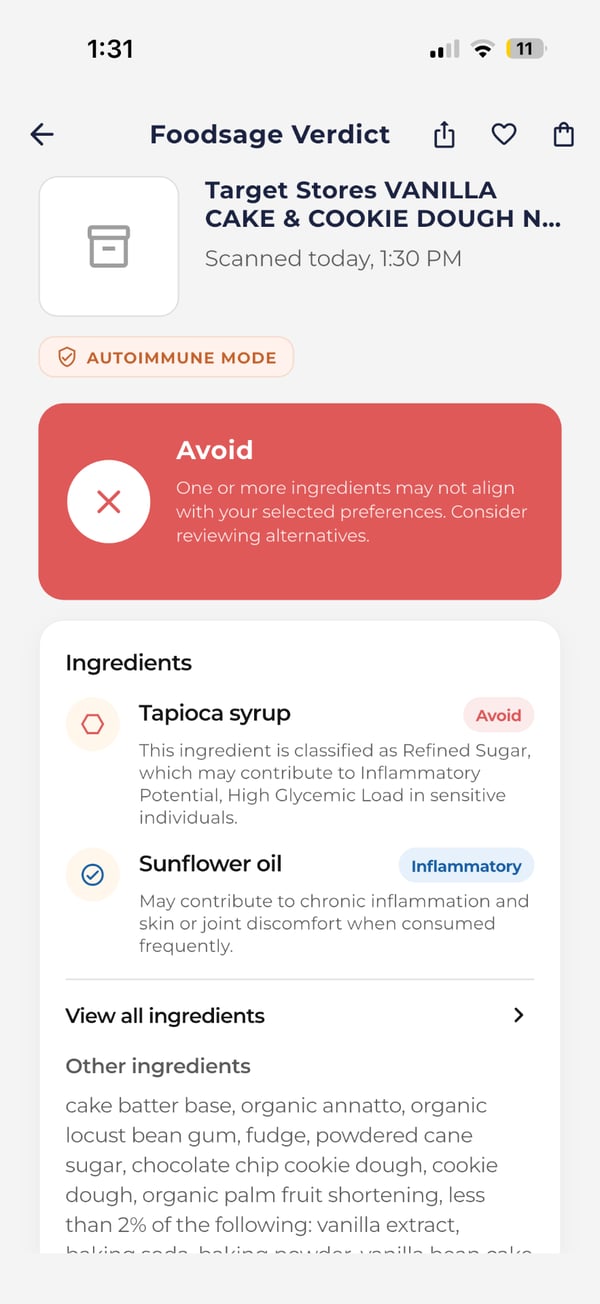
Foodsage highlights common inflammatory ingredients and suggests friendlier alternatives based on the profile you set up. It does not measure inflammation in your body, and it does not diagnose or treat any condition. For how it compares with another scanner, see Foodsage vs. Fig App.
What a Day of Eating Might Look Like
This is an illustration built from the food groups Harvard lists, not a prescribed plan, and portions are yours to set with your doctor or dietitian.
- Breakfast: oats or another high-fiber whole grain with berries and nuts, and tea or coffee.
- Lunch: a bean or lentil salad with a variety of vegetables, dressed with olive oil.
- Snack: fruit, or a handful of nuts or seeds.
- Dinner: baked fish with roasted vegetables and a whole grain, seasoned with herbs and spices such as ginger or turmeric.
- Drinks: water, tea or coffee instead of sugary drinks.
The harder part is packaged food. Sauces, breads, crackers, snack bars and dressings are where added sugars, refined starches, seed oils and additives collect, and where an ingredient scan pays for itself.
How to Start an Anti-Inflammatory Way of Eating
- Add before you remove. Put vegetables, fruit, legumes, fish and olive oil on more plates before cutting anything.
- Swap the drinks. Sugary drinks are on every list of foods to limit, and water, tea and coffee are easy replacements.
- Read ingredient lists on the packaged foods you buy most often, and note the ones that contain the categories you want to limit.
- Plan meals. Harvard points out that the pattern needs some cooking and meal planning, which some people need help to build.
- Watch portions. Harvard also notes the diet sets no calorie or portion guidance, so weight gain is still possible with large portions.
- Keep a food and symptom log for a few weeks if you have a condition, and bring it to your doctor or dietitian.
Ready to put it on the plate? Try our 7-day anti-inflammatory diet meal plan and the matching anti-inflammatory diet recipes. If you have arthritis, see the anti-inflammatory diet for arthritis for what Harvard Health and the Arthritis Foundation say and how strong the evidence is.
Who Should Be Careful
- If you have an autoimmune or digestive condition, check with your doctor or a registered dietitian before changing your diet, and do not stop treatment because of it. Harvard describes the research on rheumatoid arthritis as limited.
- If you have, or have had, an eating disorder, strict food rules and tracking can be harmful. Talk to your care team first.
- If you have persistent diarrhea, blood in your stool, unexplained weight loss or ongoing abdominal pain, see a doctor. These need medical assessment, not a diet.
This guide is general information, not medical advice. Foodsage provides ingredient information to help you shop. It does not diagnose or treat any condition.
Cluster articles
- Pillar guideHow to Reduce Belly Fat: What Works, What Doesn't and Where Inflammation Fits
- GuideAnti-Inflammatory Diet Meal Plan: A 7-Day Sample Menu and Shopping List
- GuideAnti-Inflammatory Diet Recipes: 10 Simple Recipes Built on Whole Foods
- GuideAnti-Inflammatory Diet for Arthritis: What the Evidence Shows
- GuideAIP Diet: Foods, Phases and What the Evidence Shows
- GuideThe Complete List of Seed Oils to Avoid (and What to Use Instead)
- GuideFood additives to avoid: a guide to reading food labels
- GuideHow to Avoid Emulsifiers in Food
- GuideFoodsage vs. Fig App: Which Food Scanner Fits Your Diet?
Bring inclusive wellness benefits to your team.
MetricPoint gives employers a modern, everyday wellness benefit employees actually use.
Request Demo