
Food Scanner for Hashimoto's and Celiac Disease: What to Check and What to Know
What a food scanner can and cannot do for Hashimoto's and celiac disease: gluten, iodine, hidden ingredients, testing before diet changes, and how Foodsage checks labels.
Quick answer: A food scanner for Hashimoto's and celiac disease reads a product's ingredient list and flags what you chose to avoid, such as gluten grains, so you do not have to decode labels by hand. It cannot test the food or confirm it is free of cross-contact, and it should not replace testing or medical advice. Foodsage lets you set both conditions and names the ingredients that matched.
Hashimoto's disease and celiac disease are both autoimmune conditions, and they can occur together. People who have one often have to read labels closely, for different reasons. This guide explains what is known about the link, what the evidence says about gluten and Hashimoto's, and what a scanner can and cannot do.
How Hashimoto's and Celiac Disease Are Connected
NIDDK describes celiac disease as a chronic digestive and immune disorder that damages the small intestine and is triggered by eating gluten, a protein in wheat, barley and rye. It says about 1 percent of people worldwide have it, and that many are undiagnosed. People with celiac disease can also have other immune-related disorders, including type 1 diabetes and thyroid diseases such as Hashimoto's disease and Graves' disease.
NIDDK describes Hashimoto's disease as an autoimmune disorder that can cause hypothyroidism, or an underactive thyroid. Many people have no symptoms at first. Later symptoms include fatigue, weight gain and cold intolerance, and treatment for hypothyroidism is typically levothyroxine.
Get Tested Before You Change Your Diet
NIDDK says celiac disease is usually diagnosed with blood tests and biopsies of the small intestine, and that you should not start a gluten-free diet before testing because it can affect the results. If you have Hashimoto's and digestive symptoms, fatigue you cannot explain, or a family history of celiac disease, ask your doctor about testing before you remove gluten.
What the Evidence Says About Gluten and Hashimoto's
For celiac disease, a strict gluten-free diet is the treatment. For Hashimoto's alone, the evidence is much weaker. A small 2019 pilot study in Experimental and Clinical Endocrinology & Diabetes followed 34 women with Hashimoto's who had incidentally positive anti-tissue transglutaminase antibodies. Over 6 months, those who followed a gluten-free diet had lower thyroid antibody levels than those who did not, and the authors suggested the diet may bring clinical benefit. It was a small pilot, and the abstract does not say whether allocation was random.
A 2021 literature review in the Annals of Agricultural and Environmental Medicine reached a more cautious conclusion: existing human studies do not support advising Hashimoto's patients to avoid gluten, because the studies are few, have major limitations and give mixed results, and gluten-free diets may cause nutritional deficiencies. The fair reading is that gluten matters if you have celiac disease or another reason to avoid it, and is unproven for Hashimoto's by itself. Decide with your doctor.
Iodine and Hashimoto's
NIDDK says the thyroid needs iodine, but people with Hashimoto's may be sensitive to harmful side effects from too much, and that high-iodine foods such as seaweed and iodine supplements can worsen hypothyroidism. It says researchers are studying selenium and vitamin D, but no specific guidance is currently available. See our guide to hypothyroid foods to eat, limit and time for more, and ask your doctor before taking supplements.
What a Food Scanner Can and Cannot Do
What it can do
- Read a long ingredient list in seconds and flag the items you chose to avoid.
- Catch gluten-containing ingredients that are not obvious, such as some thickeners and flavorings. See hidden sources of gluten.
- Apply several conditions and sensitivities at once.
- Suggest alternatives so you do not leave the aisle empty-handed.
What it cannot do
- Test the food. It reads the label, not the product.
- Tell you about cross-contact in manufacturing. For celiac disease, always read the allergen and may-contain statements yourself.
- Diagnose or treat any condition, or replace testing.
- Know about a recipe change after the database was last updated, so check the package in your hand.
How Foodsage Works for Hashimoto's and Celiac Disease
Foodsage is MetricPoint's ingredient checker. In setup you choose the conditions that apply to you, including celiac disease and Hashimoto's, along with others such as diabetes, IBD, Graves' disease, lupus, PCOS, multiple sclerosis and rheumatoid arthritis. You can add custom sensitivities, including gluten, dairy, FODMAP, nightshade and soy, and choose avoid categories such as gluten grains, industrial seed oils, added sugars and sweeteners, artificial additives and preservatives, refined starches and nitrates and nitrites.
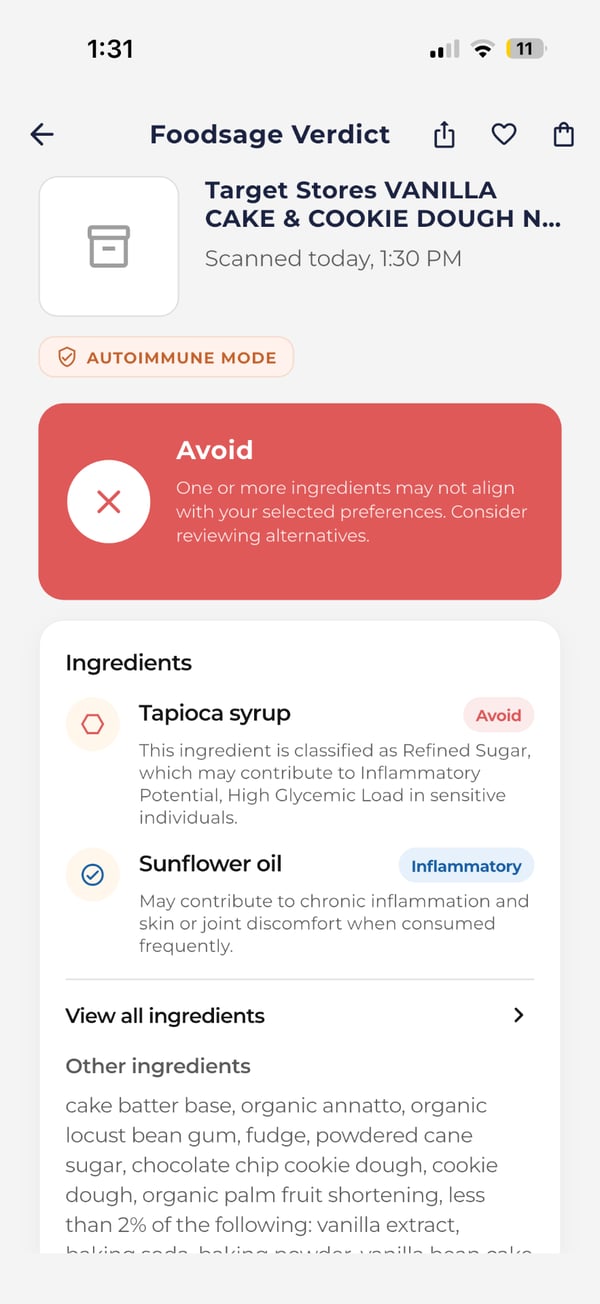
A scan returns a verdict and the specific ingredients that matched your profile. The app also has an Autoimmune mode, suggested alternatives, a meal and symptom log and personalized weekly meal plans. For people with autoimmune conditions who also want to avoid inflammatory ingredients, we think it is the strongest fit among food scanners, because the profile, the verdict and the explanation are all built around that. Fig, another scanner, covers a very wide range of diets and allergies, and we compare the two in Foodsage vs. Fig App.
A Simple Label Routine
- Scan the product and read the verdict and the matched ingredients.
- Read the label yourself, including the allergen statement and any may-contain warning.
- If you have celiac disease, look for a gluten-free label on products that carry one.
- Note your symptoms in a log and share it with your doctor or dietitian.
This guide is general information, not medical advice. Foodsage provides ingredient information to help you shop. It does not diagnose or treat any condition. Talk to your doctor or a registered dietitian about gluten, iodine and supplements.
Continue reading
- GuideCeliac Diet for Beginners: What to Eat, Meal Ideas and Nutrient Gaps
- GuideHidden Sources of Gluten: Ingredients That Sneak onto Food Labels
- GuideHypothyroid Foods: What to Eat, Limit and Time Around Levothyroxine
- GuideHyperthyroid Diet: What to Eat, What to Limit and What Diet Cannot Do
- GuideFoodsage vs. Fig App: Which Food Scanner Fits Your Diet?
Bring inclusive wellness benefits to your team.
MetricPoint gives employers a modern, everyday wellness benefit employees actually use.
Request Demo