
IBD Diet: What to Eat With Crohn's or Colitis, and What the Trials Show
There is no single IBD diet. See what guidelines and trials say about the Mediterranean, SCD, CDED and low-FODMAP diets, flares and remission.
Quick answer: There is no single diet proven to treat inflammatory bowel disease. The AGA advises a Mediterranean-style diet for most people with IBD and limiting ultra-processed foods. In a large Crohn's trial, it worked about as well as the stricter Specific Carbohydrate Diet. Flares, strictures and nutrient gaps change what fits, so plan with your gastroenterologist or a registered dietitian.
Inflammatory bowel disease (IBD) covers Crohn's disease and ulcerative colitis. This guide looks at the question behind most food searches after a diagnosis: is there an IBD diet, and which named diets have real evidence? For the detailed lists of what to limit, see our guides to foods to avoid with Crohn's disease and foods to avoid with ulcerative colitis. This is general information, not medical advice.
Is There an IBD Diet?
Not one that treats the disease. NIDDK says researchers have not found that specific foods cause or worsen Crohn's disease or ulcerative colitis symptoms, and responses differ from person to person. The American Gastroenterological Association's 2024 clinical practice update on diet in IBD says no diet has consistently been found to decrease the rate of flares in adults.
Diet still matters. It affects symptoms, energy and nutrition, and the AGA notes that dietary restrictions, along with the complications of IBD, can lead to malnutrition, which it calls under-recognized in people with IBD. The goal is a diet that keeps you well nourished and that you can actually live with.
What the Guidelines Recommend for Most People
The AGA update is an expert review, so it does not grade the evidence. Its main points for people with IBD:
- Follow a Mediterranean diet unless there is a reason not to, with changes to food texture if you have strictures or obstructions.
- Limit ultra-processed foods.
- Get checked for vitamin D and iron deficiency, and for vitamin B12 deficiency after extensive ileal disease or ileal surgery.
- Work with a registered dietitian if your IBD is complicated.
In Europe, the ESPEN guideline on clinical nutrition in IBD (2023) sets out 71 graded recommendations for clinicians, covering active disease and remission. A Mediterranean pattern in practice means plenty of vegetables, fruit, whole grains, legumes, olive oil and fish, with less red and processed meat. Our anti-inflammatory diet guide covers the wider pattern.
Crohn's Disease vs Ulcerative Colitis: Where Eating Differs
Crohn's disease can affect any part of the digestive tract, including the small intestine, where most nutrients are absorbed. That makes absorption problems more likely, and the AGA advises watching vitamin B12 after extensive ileal disease or surgery. Some people with Crohn's develop strictures, narrowed sections of bowel, and the AGA recommends careful chewing and cooking fruits and vegetables to a soft, less fibrous consistency. Our Crohn's guide covers strictures in more detail.
Ulcerative colitis affects the colon and rectum. Bleeding can lower iron levels, and flares often bring urgency and diarrhea that change what feels manageable. Our ulcerative colitis guide covers flare-time limits. In both conditions, no single food is unsafe for everyone.
Named IBD Diets and the Evidence Behind Them
Crohn's and Colitis Canada's overview of types of diets in IBD says no single diet is recommended for IBD. Here is what the trials behind the best-known options show.
Mediterranean Diet
The AGA's default for people with IBD, partly because of its wider health benefits. Crohn's and Colitis Canada notes that evidence for it specifically in IBD is still lacking, so it is best seen as a sensible, sustainable base rather than a treatment.
Specific Carbohydrate Diet (SCD)
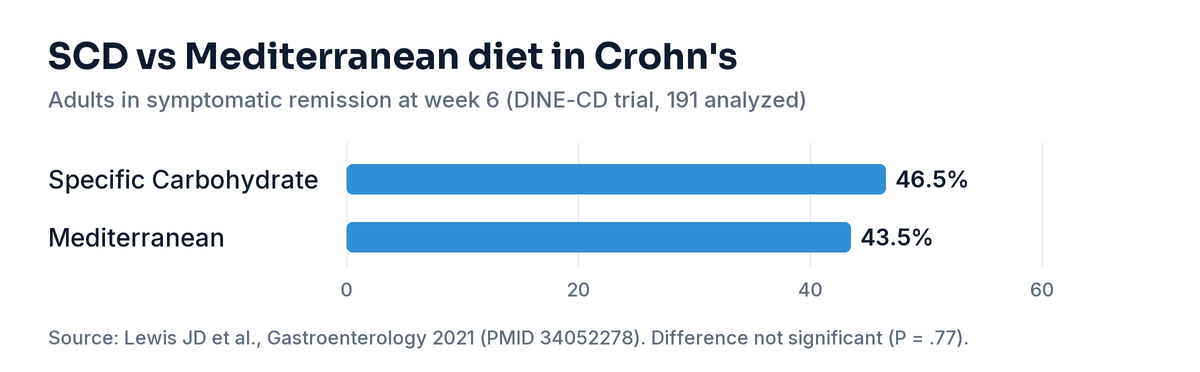
The SCD removes grains, most sugars and many starches. The DINE-CD trial (Lewis et al., 2021) randomized 194 adults with mild to moderate Crohn's symptoms to the SCD or a Mediterranean diet for 12 weeks, with prepared meals for the first 6 weeks. At week 6, 46.5% on the SCD and 43.5% on the Mediterranean diet were in symptomatic remission, a difference that was not significant. Inflammation marker responses were also similar, and uncommon. The authors concluded that the Mediterranean diet may be preferred for most patients because it is easier to follow and has other health benefits.
Crohn's Disease Exclusion Diet (CDED)
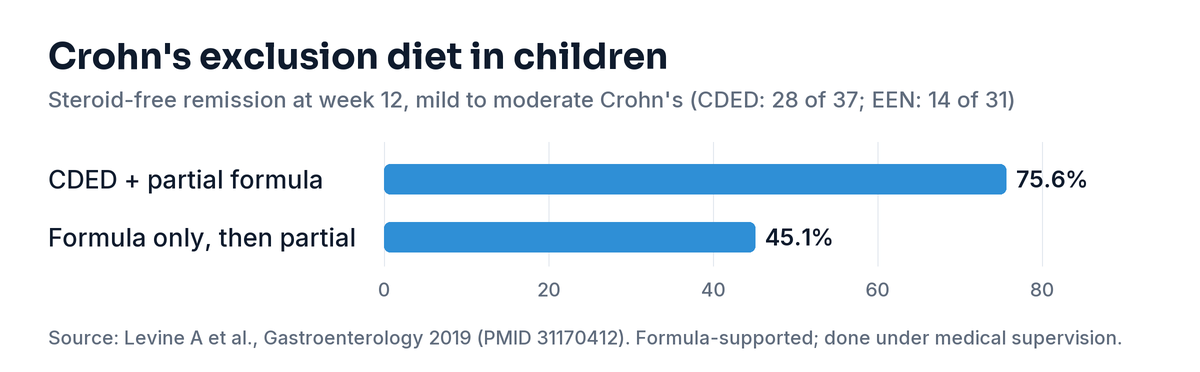
The CDED is a structured whole-food diet combined with partial enteral nutrition, meaning part of the day's calories come from a liquid formula. In a 12-week trial in children with mild to moderate Crohn's (Levine et al., 2019), 97.5% tolerated the CDED with formula compared with 73.6% on formula alone. At week 12, 75.6% of children on the CDED (28 of 37) were in steroid-free remission, compared with 45.1% (14 of 31) who had formula alone and then a free diet with partial formula. These are children treated with a clinical team, so the results should not be read as a do-it-yourself plan for adults.
Exclusive Enteral Nutrition
This means a liquid formula as the only source of nutrition for a set period. Crohn's and Colitis Canada lists it, with the CDED, as one of the two options with randomized trial support in children, and the AGA update says enteral nutrition can help induce remission in Crohn's disease and correct malnutrition before surgery. It is a medical treatment that your gastroenterology team sets up, never a self-directed cleanse.
Low-FODMAP Diet
Some people whose IBD is in remission still have IBS-like symptoms such as bloating and diarrhea. In a 4-week trial of 52 people with quiescent Crohn's or ulcerative colitis (Cox et al., 2020), 52% on a low-FODMAP diet reported adequate relief of gut symptoms, compared with 16% on a control diet. Markers of inflammation did not differ, and some beneficial gut bacteria fell. Crohn's and Colitis Canada also says studies do not show the diet reduces inflammation in IBD. It is a short-term symptom tool, best done with a dietitian. Our roundup of low-FODMAP apps can help, and foods to avoid with IBS explains a different condition that is often confused with IBD.
Other Named Diets
The IBD-AID, gluten-free, paleo and autoimmune protocol diets are popular, but evidence for them in IBD comes from small studies or none. The more a diet restricts, the greater the risk of the malnutrition the AGA warns about, so discuss any of them with your care team first.
Eating During a Flare vs in Remission
During a Flare
Stick to foods you know you tolerate. The AGA's patient diet tips for IBD suggest six small meals instead of three large ones. Many gastroenterology teams suggest less fiber and fewer fresh fruits and vegetables for a short time, then adding foods back slowly once symptoms settle. Our ulcerative colitis and Crohn's guides list these short-term limits.
In Remission
Aim for variety and a Mediterranean-style pattern, and avoid keeping flare-time restrictions longer than you need them. The AGA patient tips suggest limiting red and processed meats, trying lactose-free dairy if dairy causes symptoms, and limiting sugar alcohols and artificial sweeteners.
Nutrition Gaps to Watch
- Iron and vitamin D: the AGA advises checking these in everyone with IBD.
- Vitamin B12: watch after extensive ileal Crohn's disease or ileal surgery.
- Calcium: if you cut back on dairy, ask how to replace it, because lactose-free dairy may suit you.
- Unwanted weight loss: the AGA patient tips suggest adding calorie-dense foods and possibly supplements. Ask your care team before starting any supplement.
NIDDK notes that in children with IBD, poor nutrition may affect growth and development, so children need their diet planned with their care team.
A Sample Day of Mediterranean-Style Eating in Remission
This is an example of the pattern, not a prescription. Adjust portions and textures with your care team, especially if you have strictures.
- Breakfast: oatmeal with banana and a spoon of nut butter, or yogurt or a lactose-free alternative if dairy bothers you.
- Lunch: lentil or chicken soup with well-cooked vegetables, and sourdough or another bread you tolerate.
- Snack: a ripe pear or canned peaches, and a handful of crackers.
- Dinner: baked salmon with olive oil, rice or potatoes, and soft-cooked carrots or zucchini. With a stricture, peel and cook vegetables until soft.
Reading Labels and Tracking What You Eat

Limiting ultra-processed food is about a pattern, not one ingredient. If you want to look up specific ingredients, our IBD ingredient pages have details on, for example, lactose, sorbitol, inulin, maltodextrin and lecithin. Treat them as background for a conversation with your care team, not as rules.
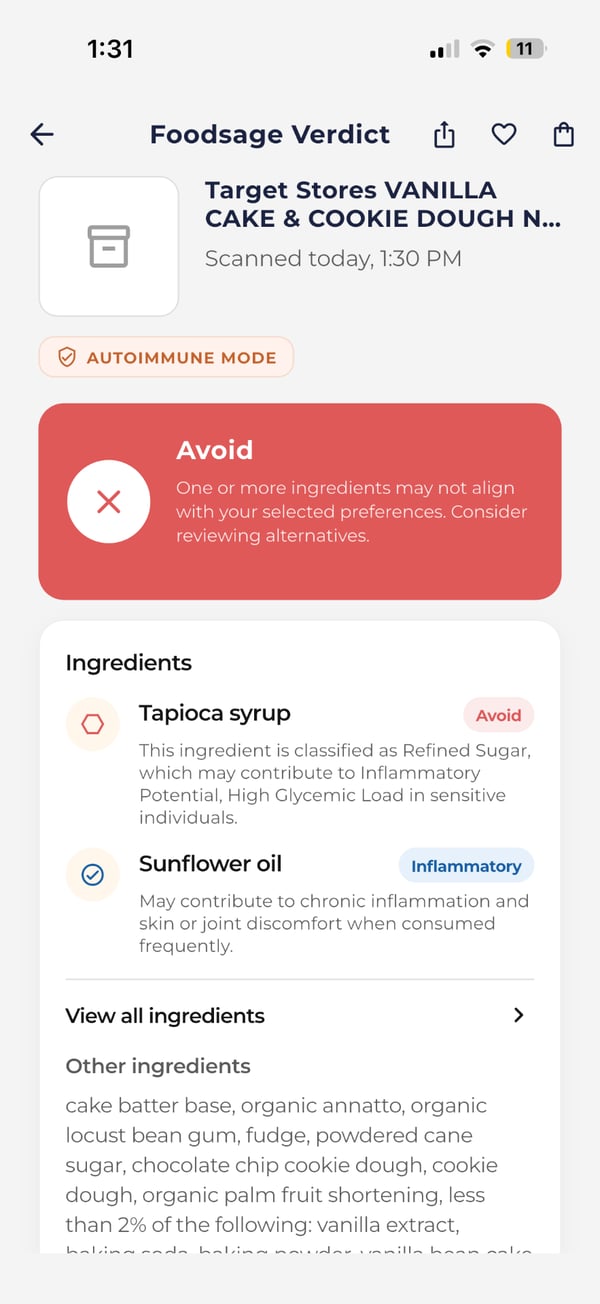
NIDDK suggests a food diary to spot foods that seem to make symptoms worse. Our food diary app guide covers what to log. Foodsage is an ingredient checker: you can choose IBD as one of your conditions, add custom sensitivities, and choose avoid categories such as artificial additives, added sugars and industrial seed oils, then scan a barcode or ingredient list and see which ingredients matched. It also has a meal and symptom log. It does not know your personal triggers unless you enter them, and it does not diagnose or treat IBD.
When to See Your Doctor or a Dietitian
- Before starting any restrictive diet, including the SCD, CDED or low-FODMAP diet.
- If you are losing weight without trying, or avoiding many foods.
- For a child with IBD.
- If you have strictures, or before or after bowel surgery.
Severe abdominal pain, a swollen abdomen, repeated vomiting, heavy bleeding or signs of dehydration need urgent medical attention. Never stop or change a medicine because of a diet. This guide is general information, not medical advice.
Continue reading
- GuideFoods to Avoid With Crohn's Disease: What the Research Says and What to Track
- GuideFoods to Avoid With Ulcerative Colitis: What the Research Says and What to Track
- Pillar guideAnti-Inflammatory Diet: What to Eat, What to Avoid and What the Evidence Shows
- GuideFood Diary Apps: What to Track and How to Pick One
- GuideBest Low FODMAP Apps in 2026: Monash, FODMAP Friendly, Fig and Foodsage Compared
- GuideFoods to Avoid With IBS: How to Spot Common Triggers on Food Labels
Bring inclusive wellness benefits to your team.
MetricPoint gives employers a modern, everyday wellness benefit employees actually use.
Request Demo