
Calorie Counting Apps: How They Work and How to Choose One
How calorie counting apps estimate what you eat, why the numbers are only estimates, who should be careful, and what to look for before you pick one.
Quick answer: A calorie counting app adds up the calories in the foods you log, using a food database and the portions you enter. The total is only as accurate as those entries and your portion sizes, and it tells you nothing about the ingredients in a product. Choose one by database quality, price and how you like to log, and be careful if tracking makes you anxious about food.
Calorie counting apps differ more than their app store pages suggest. Some are simple loggers, some track dozens of nutrients, and some adjust your targets as your weight changes. Before you pick one it helps to understand what the number on the screen really is, and what it leaves out.
How a Calorie Counting App Works
Most apps work the same way. You enter a goal or a few details about yourself, then log what you eat by searching a food database, scanning a barcode or choosing a saved meal. The app multiplies each food's calories by the amount you logged and adds the day up against a target.
The FDA's guide to the Nutrition Facts label explains what the figure means: calories are "a measure of how much energy you get from a serving of this food." It also notes that all of the amounts on a label, including calories, refer to the size of the serving, and that a serving size "is not a recommendation of how much you should eat or drink." The agency describes 2,000 calories a day as a general guide for nutrition advice, not a personal target.
Why the Numbers Are Estimates
- Portions are the biggest source of error. A heaped bowl and a measured cup can differ by a lot, and the app logs whatever you tell it.
- Labels are approximate. Under FDA rules a food is considered misbranded if its calories are more than 20 percent above the stated value, and the rule does not work in the other direction, so the real number can be higher than the label. See the Code of Federal Regulations, 21 CFR 101.9 for the labeling rules.
- Databases differ. Some apps describe their nutrition data as verified or lab-analyzed, and others rely more on entries from users, so two apps can show different calories for the same food. Check how an app describes its database before you rely on it.
- Restaurant and home-cooked meals are estimates. A dish with sauces, oil and hidden ingredients is hard to measure, so many apps use a generic entry.
None of this makes tracking useless. It means the number is a rough guide to compare days and notice patterns, not a precise measurement.
Does Counting Calories Help?
Reviews of weight-loss studies have linked consistent self-monitoring of food intake with greater weight loss, which is the main reason calorie counting is so widely recommended. The finding describes people who stuck with logging, and it does not show that logging causes weight loss in everyone. Whether it is worth doing depends on your goal, your health and how you feel about tracking. If you have a medical reason to manage your diet, such as diabetes, ask your care team whether calories, carbohydrates or something else is the number that matters for you.
Who Should Be Careful With Calorie Tracking
A 2017 study in the journal Eating Behaviors, by Simpson and Mazzeo, looked at calorie counting and fitness tracking technology and reported that people who used a phone app to track calories were more likely to report eating disorder symptoms. The authors suggested that monitoring intake on a device might increase the rigidity that comes with counting. This is an association in one sample, and it may also be that people who already worry about eating are the ones who start tracking. Either way, it is a reason for caution.
- If you have or have had an eating disorder, talk to your care team before using any calorie or food-tracking app.
- If logging makes you anxious, guilty or rigid about food, stop and speak to a clinician or registered dietitian.
- If you are pregnant, feeding a young child or managing a condition such as diabetes, ask your clinician what to track. Calories alone may not be the right measure.
What to Look for in a Calorie Counting App
- How you log. Barcode scanning, search, saved meals and photo or voice logging all save time, and some of them are paid features. Check which ones are free.
- Where the data comes from. Look for how the app describes its nutrition database and whether entries are verified or submitted by users.
- What it tracks besides calories. Some apps stop at calories and macros, and others track vitamins, minerals and other nutrients.
- Whether targets are fixed or adaptive. Some apps set a number once, and others adjust it as your weight and intake change.
- Cost. Note what the free version includes and what needs a subscription, from the app's own pricing page or store listing.
- Your data. Check whether you can export your history and how the app handles your privacy.
For a side-by-side look at specific apps, see our guide to MyFitnessPal alternatives.
What a Calorie Counter Does Not Tell You
Two snacks can have the same calories and very different ingredient lists. One can be made with whole foods, and the other with emulsifiers, sweeteners and preservatives that someone with a food sensitivity, an autoimmune condition or a digestive disorder would want to avoid. A calorie counter treats them the same, because it was built to measure energy, not ingredients.
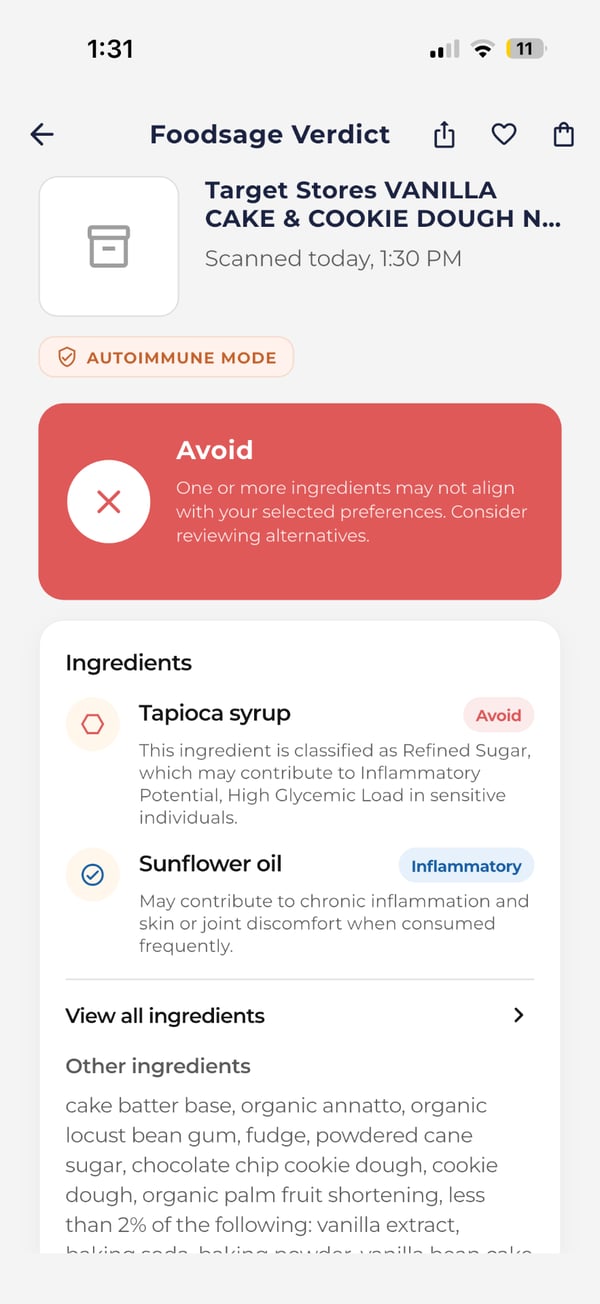
That is the gap Foodsage fills. It is an ingredient checker, not a calorie counter: you choose your conditions, sensitivities and clean-eating goals, scan a barcode or an ingredient list, and it returns a verdict with the specific ingredients that matched your choices. Many people keep the calorie counter they like and use Foodsage for the packaged foods they buy. To learn how ingredient scanners compare, see how to choose an ingredient checker app.
Use the Label as Well
Whatever app you use, the package is the primary source. Check the serving size first, because every number on the label refers to it, then read the ingredient list for anything you avoid. Foodsage provides ingredient information to help you shop. It does not diagnose or treat any condition, and nothing here is medical advice. Talk to a doctor or registered dietitian about how much to eat.
Continue reading
Bring inclusive wellness benefits to your team.
MetricPoint gives employers a modern, everyday wellness benefit employees actually use.
Request Demo